

Your best palletizing operator calls in sick at 6 AM. The biggest order of the quarter ships today. The line keeps running. Cartons keep coming. And the end-of-line scramble begins: unstable stacks, damaged product, overtime, a loading dock that falls two hours behind, and a customer who notices.
A well-specified palletizer doesn't just automate a task—it removes a single point of human failure from the most throughput-critical moment in your production day. This guide covers everything you need to specify, evaluate, and purchase the right system: how palletizers work, which specifications actually drive performance, how to compare types, and what to prepare before you request quotes for palletizers.
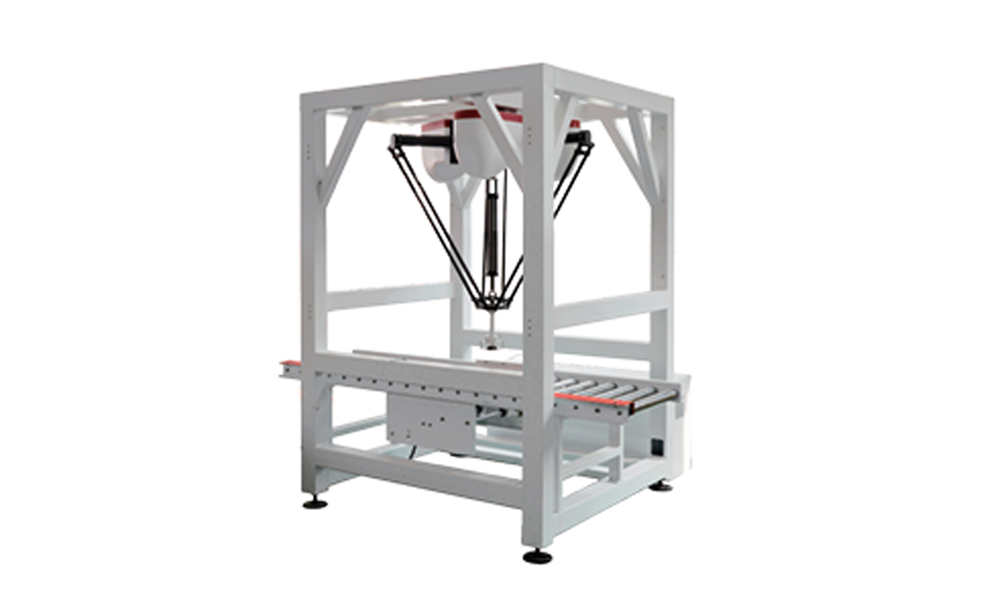
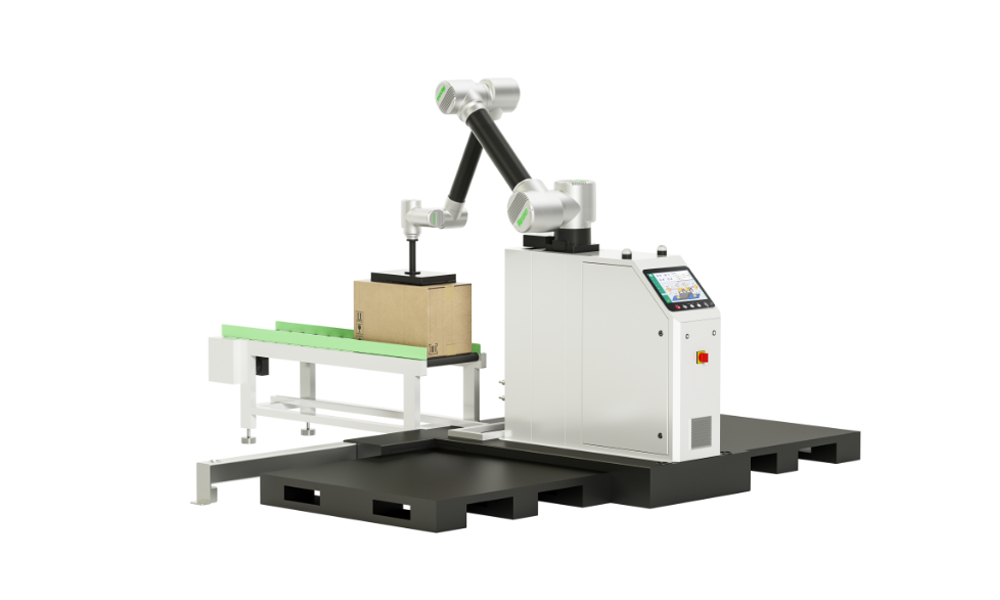
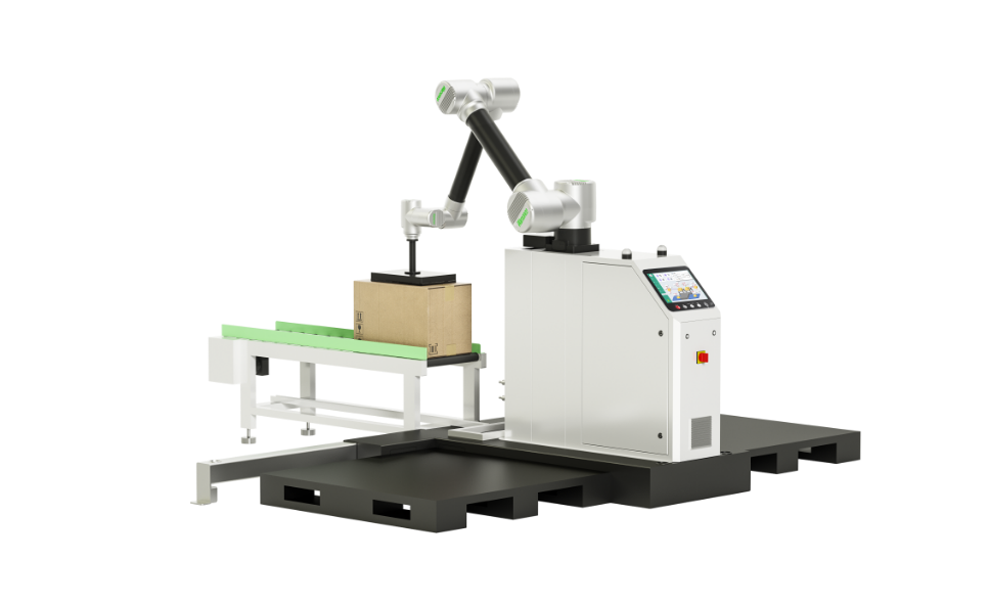
A palletizer is an automated system that stacks cases, bags, trays, or bundles onto pallets in stable, repeatable patterns—replacing or supplementing manual end-of-line labor with consistent, programmable stacking logic.
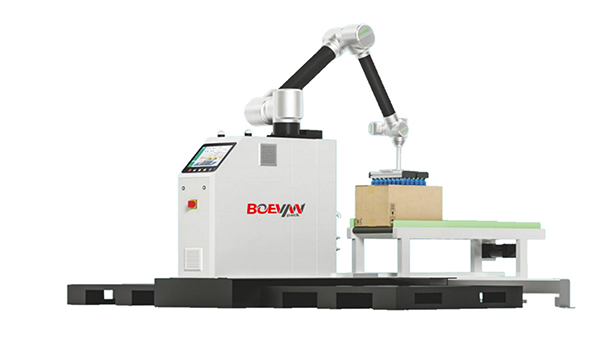
The core buying goal is matching the system to four variables: your product characteristics, your required throughput rate, your available footprint, and your labor reduction targets. A palletizer that is correctly matched to all four delivers predictable throughput, better pallet quality, and measurable labor savings. One that is mismatched on any of the four creates a bottleneck that is expensive to fix after installation.
Regardless of type, every palletizer follows the same fundamental sequence:
Infeed: products arrive from the upstream line on a conveyor; spacing and orientation are controlled before the stacking zone
Product spacing and orientation: products are aligned, squared, and spaced to match the layer pattern
Layer forming or single-pick: conventional palletizers form a complete layer before placing it; robotic palletizers pick individual products or rows and place them directly
Pallet build: layers are stacked in the programmed pattern until the pallet is complete
Pallet discharge: the completed pallet is conveyed to the stretch wrapper or staging area; an empty pallet is loaded for the next build
The stacking pattern is not cosmetic—it determines whether the pallet survives transit. Key pattern principles:
Interlocking patterns: alternating layer orientations tie the stack together and prevent column collapse
Corner support: products at the pallet corners carry the most compressive load during transit; pattern design must account for this
Layer integrity: consistent product dimensions and orientation are required for stable layers; inconsistent cartons or bags are the most common source of unstable pallets
Slip sheets: used between layers or under the bottom layer to improve stability and protect product surfaces
The control system determines how easy the palletizer is to operate and integrate:
Recipe management: each SKU and pallet pattern is stored as a recipe; changeover is a recipe selection, not a mechanical adjustment
Fault recovery: clear fault messaging and guided recovery procedures reduce downtime when the system stops
OEE data readiness: modern palletizers should provide cycle count, uptime, and fault frequency data for production reporting
Integration interfaces: the control system must communicate with upstream case packers, downstream stretch wrappers, and plant-level MES/ERP systems
A palletizing robot is the right choice when:
You have high SKU variety with frequent pattern changes
You need to serve multiple lines from a single system
Your product mix includes both cases and bags
You need complex patterns that conventional layer-forming cannot achieve
Conventional palletizers are the right choice when:
You have high, consistent throughput on a single SKU
Your patterns are stable and changeover frequency is low
Speed is the primary requirement
This is the section most buyers skip—and the reason most specification mistakes happen. A palletizer is not a commodity; the specifications that determine whether it performs in your application are specific to your product, your line, and your facility.
| Specification | What to Define |
|---|---|
| Throughput (cases or bags per minute) | Specify both sustained rate and peak rate; the palletizer must handle peak without accumulation backup |
| Layer change time | Time to complete one layer and begin the next; affects sustained throughput at high speeds |
| SKU changeover time | Time to switch from one recipe/pattern to another; critical for high-mix operations |
| Uptime target | Define the OEE target; confirm the supplier's reference data for your product type |
Common specification mistake: specifying average throughput without accounting for peak. If your line runs at 20 cases per minute average but peaks at 28 cases per minute during label changes and line catches, the palletizer must handle 28—not 20.
| Parameter | Why It Matters |
|---|---|
| Case/bag dimensions (L × W × H) | Determines layer pattern geometry and end effector selection |
| Weight range | Affects end effector load rating and conveyor specifications |
| Surface friction | Low-friction surfaces (film-wrapped cases) require different handling than high-friction corrugated |
| Compressibility (bags) | Compressible products require different layer-forming logic than rigid cases |
| Fragility | Fragile products require controlled placement force and acceleration limits |
Pallet size: confirm the standard pallet size for your market (48×40 inch GMA in North America; 1200×800mm EUR pallet in Europe; confirm for your distribution network)
Pallet quality variability: if you use recycled pallets with dimensional variation, the palletizer must accommodate the variation without misalignment
Pattern library: confirm the number of patterns available and the process for adding new patterns
Slip sheet capability: if your product or customer requires slip sheets between layers, confirm the palletizer's slip sheet dispenser integration
The end effector is the component that contacts the product—and it is the specification that most directly determines whether a palletizing robot handles your product reliably:
| End Effector Type | Best Application |
|---|---|
| Vacuum (suction cup) | Flat-top cases, trays, rigid surfaces |
| Clamp | Cases with consistent dimensions; side-grip applications |
| Fork/scoop | Bags, bundles, products that cannot be gripped from the top |
| Bag gripper | Flexible bags; requires specific gripper geometry for the bag format |
| Multi-pick head | High-speed applications; picks multiple products per cycle |
PLC/HMI brand preference: confirm compatibility with your plant's existing control platform for spare parts and maintenance familiarity
Remote diagnostics: confirm the supplier's remote access capability for fault diagnosis and software updates
Integration points: define the communication requirements for each upstream and downstream system before the controls specification is finalized
| Parameter | What to Confirm |
|---|---|
| Line height | The palletizer infeed height must match the upstream conveyor height |
| Ceiling height | High-level palletizers require significant ceiling clearance; confirm before layout |
| Maintenance clearance | Define minimum aisle widths around the palletizer for safe maintenance access |
| Safety guarding footprint | The guarded cell is larger than the machine; include guarding in the layout drawing |
Power: confirm voltage, phase, and amperage requirements against available supply
Compressed air: confirm pressure and flow requirements; some palletizers are all-electric (no air required)
Environment: dust, humidity, washdown requirements (food applications), and temperature extremes all affect component selection and IP rating requirements
| Criteria | Conventional (Layer-Forming) Palletizer | Robotic Palletizer |
|---|---|---|
| Throughput | High; optimized for single-SKU high-speed lines | Moderate to high; depends on pick cycle and end effector |
| SKU flexibility | Lower; pattern changes require mechanical adjustment | High; pattern changes are recipe selections |
| Product variety | Best for consistent cases or bags | Handles cases, bags, trays, bundles, mixed loads |
| Footprint | Larger; layer-forming mechanism requires space | Compact; robot cell can be configured for tight layouts |
| Multiple lines | One palletizer per line | One robot can serve two or more lines |
| Capital cost | Lower for single-line, single-SKU applications | Higher upfront; lower TCO for high-mix applications |
| Changeover time | Longer; mechanical adjustment required | Fast; recipe selection with minimal or no tooling change |
When evaluating palletizers for sale, these are the questions that separate capable suppliers from optimistic ones:
Performance evidence
Can the supplier provide cycle rate data with your specific product dimensions and weight—not a generic reference product?
Is there video evidence of the system running at the specified rate with your product type?
Changeover proof
What is the actual recipe switching time, measured from last product of SKU A to first stable layer of SKU B?
Does changeover require tooling swaps, and if so, what is the tool change time?
Support and spare parts
What is the lead time for the five most commonly replaced components?
Is there local service support, or does every service call require travel from the supplier's facility?
What is the warranty scope—parts only, or parts and labor?
Commissioning and training
What is included in the commissioning scope: installation, runoff at rate, operator training, maintenance training?
What documentation is provided: electrical drawings, mechanical drawings, spare parts list, maintenance manual?
| TCO Factor | What to Quantify |
|---|---|
| Downtime risk | Estimated annual downtime hours × cost per hour of lost production |
| Labor impact | Headcount reduction × fully loaded labor cost |
| Consumables | Slip sheets, end effector wear parts, lubricants |
| Energy and air | Annual utility cost at specified consumption rates |
| Service contract | Annual cost vs. risk of uncontracted emergency service |
| Spare parts inventory | Initial spare parts investment for critical components |
Overbuying speed you cannot feed: a palletizer rated for 30 cases per minute is wasted if your upstream line consistently delivers 18; buy for your actual line rate, not your aspirational rate
Underbuying flexibility you will need: if you are adding two new SKUs per year, a conventional palletizer with limited pattern flexibility will be a constraint within three years
Ignoring the integration scope: the palletizer is one component; the conveyors, pallet dispenser, stretch wrapper, and controls integration are often where projects go over budget
Food and beverage: high-speed case and bag palletizing; washdown requirements; strict pallet quality for retail distribution
Pet food: bag palletizing with compressible product handling; high dust environments
Chemicals and building materials: heavy cases and bags; robust end effectors; safety requirements for hazardous materials
E-commerce and 3PL: high SKU variety; frequent pattern changes; mixed-load capability
Pharma and consumer goods: precise placement; documentation requirements; clean room compatibility in some applications
| Benefit | Typical Impact |
|---|---|
| Injury reduction | Palletizing is one of the highest-injury tasks in end-of-line operations; automation eliminates repetitive lifting injuries |
| Throughput consistency | Automated palletizing maintains rated speed regardless of shift, fatigue, or staffing; eliminates end-of-shift slowdowns |
| Pallet quality | Programmed patterns produce consistent, stable pallets; reduces transit damage and customer complaints |
| Labor reallocation | Operators previously assigned to palletizing can be redeployed to higher-value quality and line management tasks |
Before requesting quotes for palletizers, prepare:
Product specification sheet: dimensions (L × W × H), weight, surface type, fragility rating
Pallet pattern requirements: pallet size, layer count, pattern type, slip sheet requirement
Layout drawing: available floor space, ceiling height, infeed conveyor height, aisle requirements
Utilities: available power (voltage/phase/amperage), compressed air (pressure/flow), network connectivity
Line rate history: average and peak cases/bags per minute over the past 90 days
SKU count and changeover frequency: number of active SKUs and average changeovers per shift
Safety review expectations: guarding standard, light curtain vs. fence preference, lockout requirements
Daily
Visual inspection of end effector for wear, damage, or contamination
Sensor cleaning (photoeyes, proximity sensors) in dusty environments
Air leak check at fittings and cylinders
Belt and chain tension visual check
Weekly
Lubrication points per the maintenance manual schedule
Fastener check on high-vibration components (end effector mounting, conveyor drives)
End effector wear item inspection (suction cups, gripper pads, fork tips)
Monthly/Quarterly
Calibration check for positioning accuracy (robotic palletizer)
Recipe backup to external storage
Safety device testing: light curtains, e-stops, safety scanners
Conveyor alignment and tracking adjustment
Full spare parts inventory review against reorder points


 English