

In modern packaging processes, case sealing is the final critical step before products leave the factory. Case sealers, as a core component of automated packaging lines, have evolved from simple tape applicators into intelligent systems integrating efficiency, precision, and flexibility. This document systematically analyzes the main types, technical differences, and selection guidelines for case sealers to provide a decision-making framework for optimizing the terminal packaging operation.
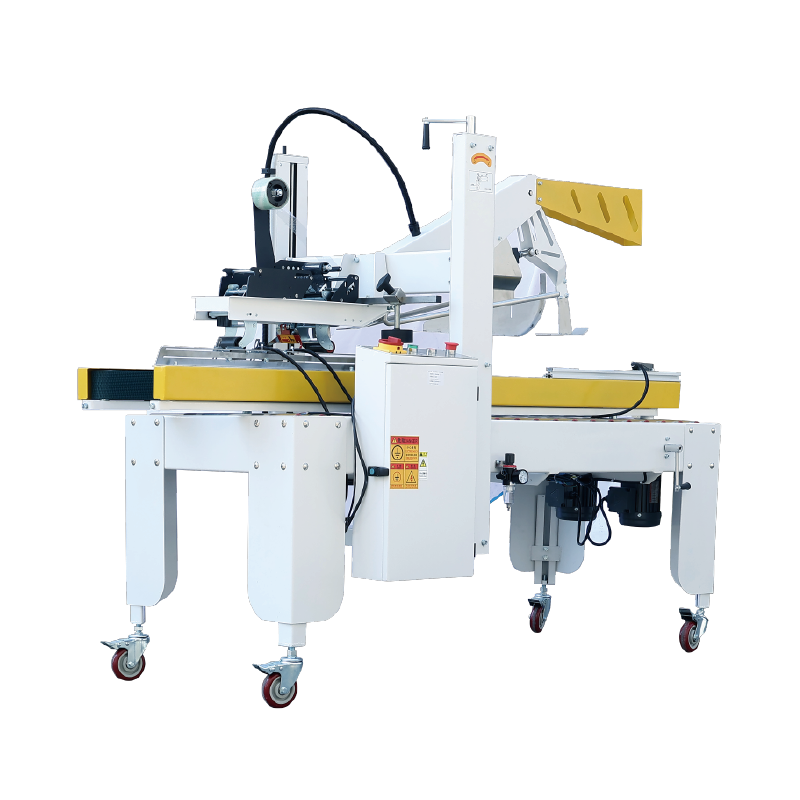
A case sealer is a packaging machine designed to automatically close the top and bottom flaps of a corrugated case and seal them using tape or hot melt adhesive. Its core function is to replace manual labor, achieving standardized and continuous case sealing operations, ensuring secure and uniform package closure, and significantly boosting production line efficiency.
The primary workflow is as follows: After products are loaded into a case, it is conveyed into the sealer. The machine first automatically folds the flaps (for automatic flap-closing models), then applies sealing material (tape or glue) precisely along the center seam or specified edges of the case through a sophisticated taping or gluing mechanism, and finally completes actions like pressing and cutting.
Based on automation level, sealing method, and functional focus, case sealers can be categorized as follows:
• By Automation Level
◦ Semi-Automatic Case Sealer: Requires an operator to place the case and initiate the cycle. The machine then automatically applies tape to seal it. It features a simple structure and lower cost, suitable for medium-to-low volume production or scenarios with frequent case size changes.
◦ Automatic / Fully Automatic Case Sealer: Can be seamlessly integrated with upstream production lines. It automatically performs the entire process of case conveying, flap closing (if equipped), sealing, and discharging, enabling unattended operation. It is designed for high-speed, high-volume production lines.
• By Sealing Process and Function
◦ Tape Case Sealer: The most common type, using BOPP or kraft paper tape for sealing. It is economical, fast, and easy to adjust.
◦ Hot Melt Glue Case Sealer: Utilizes hot melt adhesive for spray sealing. It provides a flatter case surface, ideal for subsequent printing and palletizing. This type is especially suitable for applications requiring high seal strength or involving cases with special surface treatments. Its speed can be several times that of traditional tape sealers.
◦ Automatic Top and Bottom Flap Sealer: Integrates an automatic flap closing mechanism to fold upright flaps flat before sealing, further reducing manual intervention. This is a key model for achieving full automation.
◦ Corner Sealer and Side Sealer: Used to provide additional reinforcement sealing on specific corners or the sides of a case. Commonly employed for heavy products or shipments requiring long-distance transport to enhance overall protection.
• Size Adjustment Flexibility: How quickly the machine adapts to frequent case size changes. Electric adjustment is more efficient than fully manual.
• Material Compatibility: Confirm the usable tape width (e.g., 48mm, 60mm, 72mm) or type of hot melt adhesive required.
• Line Integration Capability: Ease of integration with upstream case formers/erectors, packing stations, and downstream palletizers to form a complete automated packaging line.
Correct selection begins with a clear analysis of your production requirements:
• Choose a Semi-Automatic Case Sealer if: Your production involves many batches with varied case sizes, initial investment budget is limited, or your line is not fully automated. It significantly improves sealing quality and worker efficiency at a lower cost.
• Choose a Fully Automatic Tape Case Sealer (with flap closing) if: You operate a stable, continuous production line with relatively fixed case sizes and pursue high output with reduced labor. This is the mainstream and cost-effective choice for most automated factories.
• Choose a Hot Melt Glue Case Sealer if: Your production cycle demands extreme speed (e.g., over 40 cases per minute), or your product requires special packaging appearance, seal strength, and palletizing stability. This is often the ultimate solution for upgrading high-output, high-speed production lines.
Additionally, factors such as structural robustness (e.g., high-strength frame), control system stability (e.g., PLC control), and safety features (e.g., safety guards with interlock switches) are crucial for ensuring long-term, reliable operation.
Boevanpack Technologies is a leading provider of packaging automation solutions, specializing in the R&D and manufacturing of high-performance case sealing and end-of-line packaging equipment. We deeply understand the efficiency, cost, and consistency challenges our customers across various industries face at the packaging terminal.
Our product portfolio comprehensively covers needs from semi-automatic to fully automatic, and from standard tape sealing to high-speed hot melt glue sealing. Notably, our Series of Automatic Top and Bottom Flap Sealers integrate a high-rigidity structure, intelligent PLC control, and precise servo-drive technology, ensuring reliability and sealing accuracy under continuous, demanding operations. For customers with unique requirements, we offer professional custom engineering services to ensure the equipment integrates perfectly into your production line.
Choosing Boevanpack Technologies means you gain not just a machine, but a partner committed to enhancing your packaging efficiency. Our engineering team provides full-process support, from on-site assessment and solution design to installation and training, empowering your business to achieve intelligent upgrades in the packaging stage.
For further technical consultation or customized solutions, please feel free to contact our expert team.


 English