

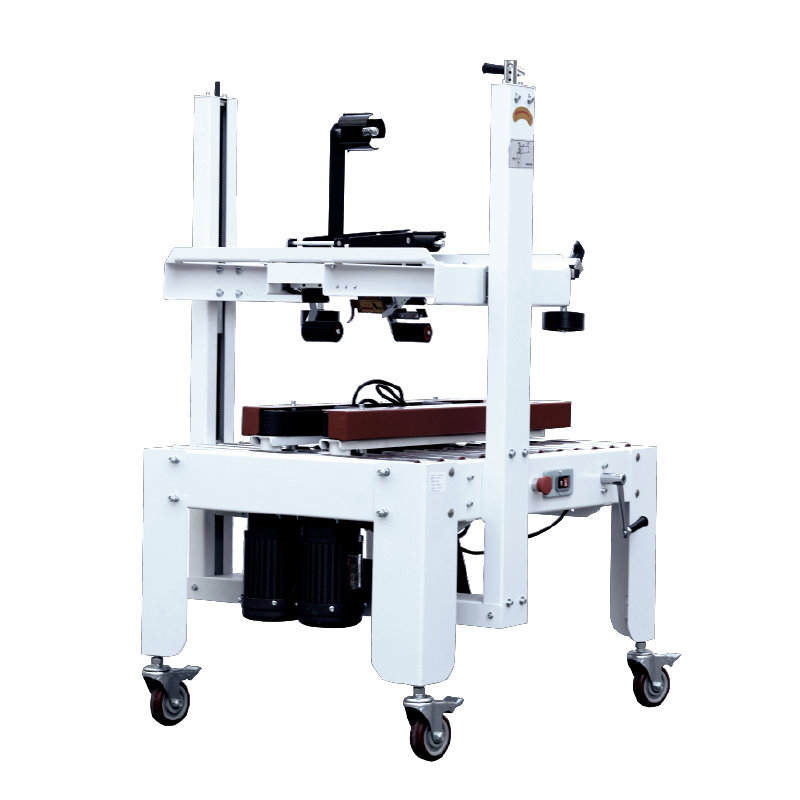
At the terminal stage of a packaging line, the choice of case sealer directly impacts packaging efficiency, cost control, and line fluency. As the two primary options, the fundamental difference between Automatic and Semi-Automatic Case Sealers lies in their level of integration with the production line and the degree of human involvement. A clear understanding of their technical boundaries and application scenarios is key to making the optimal investment decision.
The difference between Automatic and Semi-Automatic sealers extends far beyond mere speed; it stems from a differing design philosophy, leading to comprehensive variances in performance and application.
Fundamental Insight: The core of the choice is not the equipment itself, but the definition of one's own production model. The fully automatic machine serves the "continuous flow" logic of a production line, while the semi-automatic machine optimizes "cellular" workstation operations.
The correct choice is based on a rational assessment of the current situation and future goals. Please refer to the following decision-making guidance:
1. Prioritize a Semi-Automatic Case Sealer if your current situation aligns with most of the following characteristics:
• High mix of production batches, low volume: Carton specifications change frequently throughout the day, requiring extremely high switching flexibility.
• Production line is not fully automated: Upstream and downstream processes are still predominantly manual, lacking a continuous conveyor line.
• Limited initial budget: Aiming to quickly address inefficiencies, inconsistent appearance, and tape waste from manual sealing with minimal investment.
• Restricted floor space: Unable to accommodate the linear layout required for a long automatic sealing line.
• Phased or secondary need: Serves as a transitional solution for capacity upgrade, or for handling non-standard items like irregular boxes or return/rework cases at the line's end.
2. Investing in a Fully Automatic Case Sealer is imperative if your goals align with the following key directions:
• Pursuing high output and economies of scale: The production line is stable, product specifications are relatively uniform, and there is a need to achieve output of thousands or even tens of thousands of cases per shift.
• Addressing long-term labor challenges: Facing difficulties in recruitment and continuously rising labor costs, with an urgent need to replace repetitive manual positions with equipment.
• Building a coherent automated production line: Already have or plan to introduce automatic case erectors, loaders, checkweighers, labelers, etc., where sealing is the essential "final link" to connect.
• Requiring strict traceability and data integration: Need to integrate with MES systems to obtain real-time data on production capacity, fault alarms, etc., for lean management.
• Strategic positioning upgrade: Investing in automation is not merely a cost calculation but a strategic move to enhance enterprise reliability, modernize its image, and build customer confidence.
On the path to automation you need a partner with deep process expertise and trustworthiness. We are committed to transforming your investment into predictable, measurable gains in production efficiency.
1. Tailored "Diagnosis-Planning-Simulation" Advisory Service
We reject "applying standard solutions." Prior to any sale, our engineers conduct on-site diagnostics, analyzing your product characteristics, carton specifications, current cycle times, and bottlenecks. We don't just recommend a machine; we provide layout plans and dynamic simulations based on your 1-3 year capacity, ensuring the investment is future-proof and avoids costly rework.
2. Forward-Looking Modular and Intelligent Design
• Intelligent Self-Adapting Adjustment: Our automatic sealers utilize servo drives, allowing storage of hundreds of carton parameter sets on the touchscreen for "one-touch changeover," reducing size adjustment time to under one minute—balancing the efficiency of automation with the flexibility of semi-automatic operation.
• Superior Compatibility and Reliability: For our semi-automatic models, we have optimized the drive structure and tape guiding system to ensure wide compatibility—from lightweight cartons to heavy-duty corrugated boxes—with extremely low failure rates and easy maintenance.
3. Full Lifecycle Value Delivery System
We promise that our partnership begins, not ends, with equipment delivery:
• Rapid Delivery and Integration: Leveraging extensive industry experience and standard interfaces, we ensure efficient and stable integration of automatic sealers into your existing line.
• In-Depth Training and Knowledge Transfer: We provide tiered training for both operators and maintenance engineers, ensuring your team can fully utilize and optimize equipment performance.
• Proactive Remote Service & Preventive Maintenance: Our IoT-based remote monitoring platform enables operational status alerts and remote diagnostics. We offer preventive maintenance plans and proactive on-site service to maximize your Overall Equipment Effectiveness (OEE).
Automating the sealing process is a critical step in evolving packaging efficiency from "manual experience" to "process science." Whether you are in the evaluation phase or have a clear direction, we are ready to be your most professional advisor.
Welcome to contact our Packaging Automation Advisory team immediately. By providing your carton samples, production cadence, and goals, you will receive:
1. A "Sealing Process Analysis and Upgrade Path Recommendation" report tailored to your specific situation.
2. A detailed online or on-site solution demonstration and technical Q&A session.
3. A clear starting point towards a more efficient, lower-cost, and more competitive packaging process.
Let us work together to transform every sealed case into a solid brand promise and a competitive advantage.


 English