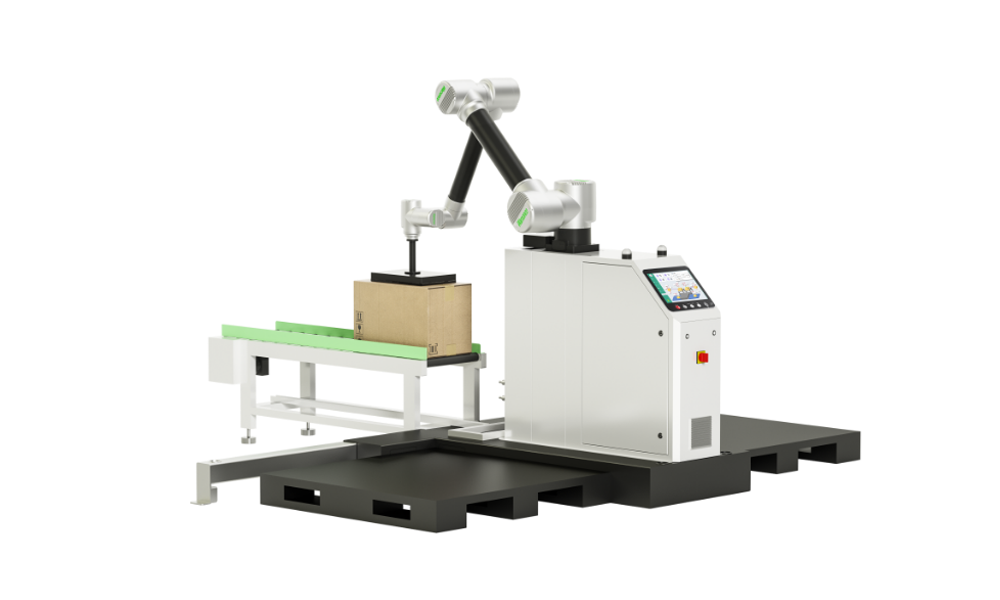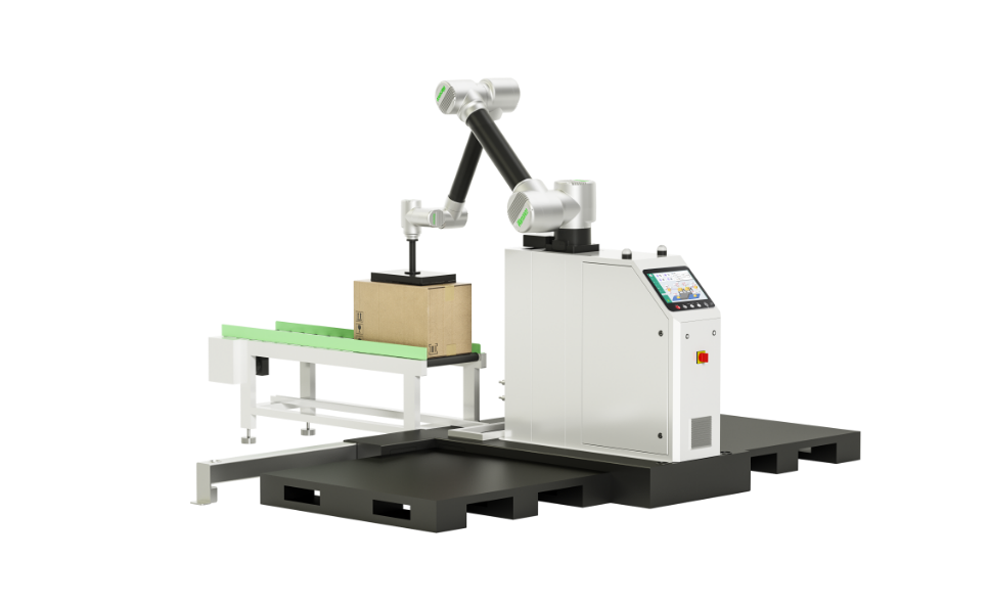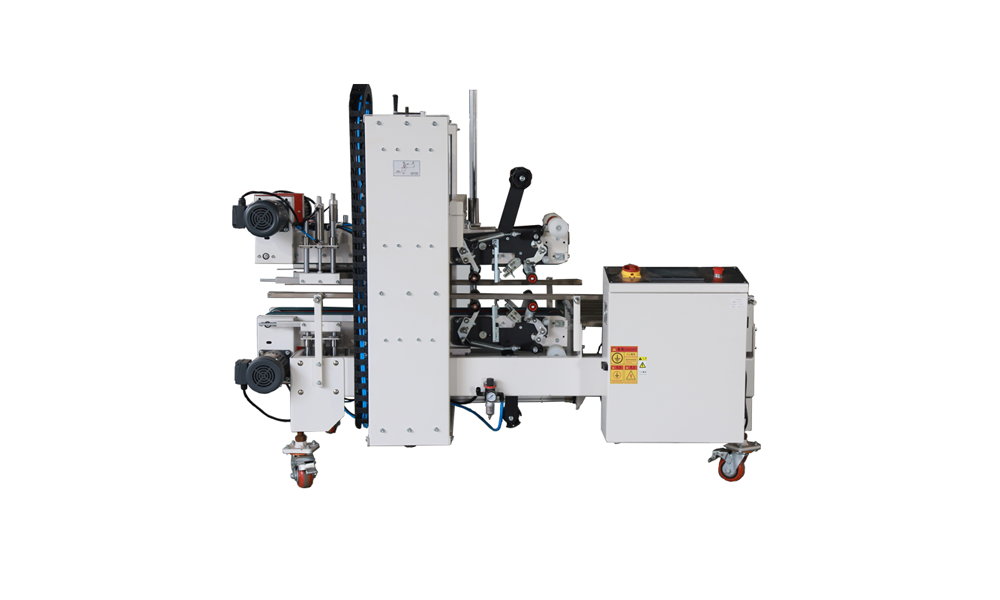


In 2026, many factories and warehouses are expanding output without expanding buildings — which makes end-of-line automation a space-planning challenge. A compact case palletizer can help operations increase throughput, improve pallet consistency, and reduce labor dependency while fitting into tight line layouts. This guide explains how a modern box packing robot supports small-footprint palletizing, what configurations work best, and what to confirm before deploying a compact cell.
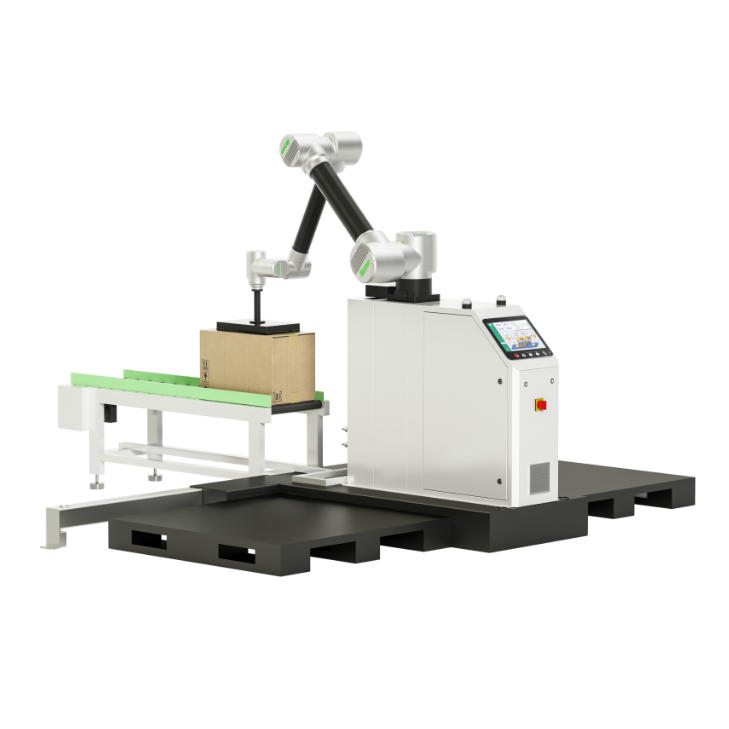
Three forces are converging in 2026 to push compact palletizing automation:
| Driver | Operational Impact | Why Compact Matters |
|---|---|---|
| Rising labor costs | Manual palletizing is expensive per case moved | ROI improves as labor costs increase |
| Staffing variability | End-of-line labor is increasingly difficult to staff consistently | Automation removes the dependency on shift-by-shift availability |
| More SKUs, shorter runs | High-mix production requires fast pattern changes | Robotic systems with recipe storage adapt faster than manual teams |
| Retrofit pressure | Most facilities have fixed floor plans | New automation must fit existing space — not the other way around |
A conventional palletizing gantry or high-level palletizer typically requires 15–30 m² of floor space plus maintenance access. Many production lines have 8–12 m² available at the end of the conveyor. A compact robotic palletizing cell designed around a collaborative or mid-size industrial robot can fit into this constraint — but only when the layout is engineered for the space rather than adapted from a standard design.
| Layout Type | Description | Footprint Range | Best Application |
|---|---|---|---|
| Inline single station | Robot at end of straight conveyor; one pallet position | 6–10 m² | Simple single-SKU lines with consistent throughput |
| Corner cell | Robot at conveyor corner; pallet position beside the conveyor | 8–12 m² | Lines where infeed comes from one direction and pallet exits another |
| Dual pallet island | Robot serves two pallet positions alternately; one fills while one is changed | 10–15 m² | Lines where pallet changeover time must not interrupt throughput |
| Overhead infeed | Cases dropped from an elevated conveyor into the cell | 5–8 m² | Very tight floor spaces; higher capital cost for elevated infeed |
Robot reach envelope: the robot arm sweep defines the minimum safe working radius — pallet position and infeed must fall within this reach
Pallet height at full stack: the robot must reach both the lowest layer (near floor level) and the highest layer (typically 1.4–1.8 m) — this affects vertical reach and robot model selection
Maintenance access: ISO safety standards require defined clearance around powered equipment — this cannot be eliminated but can be minimized with fold-away or retractable guarding
Forklift and AGV approach: the completed pallet must be removed safely — the layout must include an approach path that does not conflict with the infeed conveyor or safety barriers
Design for the pallet exit first: the most constrained and most critical flow path is the removal of completed full pallets by forklift or AGV
Minimize conveyor length: every additional metre of infeed conveyor adds cost and space — minimize the transfer distance between the production line and the robot cell
Consider pallet dispensers: automatic pallet dispensers integrated into the cell eliminate manual pallet placement and reduce operator presence inside the cell footprint
The gripper is the component that defines what product types the robot can handle and how reliably it places cases.
| Gripper Type | How It Works | Best Application | Limitation |
|---|---|---|---|
| Vacuum cup gripper | Suction cups attach to the case top surface | Flat-top cartons; regular sealed cases | Cannot handle perforated, wet, or open-top cases |
| Clamp gripper | Two plates squeeze the case from both sides | Irregular, perforated, or open-top cases | Requires more clearance between layers |
| Hybrid vacuum/clamp | Combines both mechanisms | Mixed packaging lines | Higher cost; more complex maintenance |
| Fork gripper | Slides under the case like a small fork | Trays, shallow cases, heavy cases | Requires a gap between cases on the infeed |
The layer pattern — how cases are arranged on each pallet layer — directly affects pallet stability during transport.
| Pattern Type | Description | Stability Characteristic |
|---|---|---|
| Interlock (brick) | Alternating row orientation between layers | Highest stability — cases bridge the layer joints |
| Column stack | All cases aligned in the same orientation | Lower stability — topples easily without stretch wrap |
| Split row | Mixed orientation within layers | Moderate — used when case geometry limits interlock |
The box packing robot's software pattern library defines which patterns are available and how quickly patterns can be changed when the SKU changes. A system with a larger pattern library and a recipe storage function handles high-mix production more efficiently.
| Production Profile | Key Requirement | Recommended Configuration |
|---|---|---|
| High volume, single SKU | Maximum cycles per minute; high uptime | Dedicated industrial robot with optimized gripper; high-speed infeed |
| Medium volume, moderate SKU mix | Balance of speed and changeover time | Mid-size robot with recipe storage; quick-change gripper tooling |
| Low volume, high SKU mix | Fast recipe changeover; pattern flexibility | Collaborative or flexible robot with broad pattern library; guided setup |
| Variable shift demand | Consistent output despite staffing changes | Any robotic cell; primary value is removing labor variability |
Cases per minute: confirm the robot cycle time matches or exceeds the line's maximum production rate — a palletizer that cannot keep up creates a production bottleneck
Pattern changeover time: for high-mix lines, how long does it take to change from one pallet pattern to another after a recipe change?
Uptime and MTBF: request the manufacturer's actual field MTBF data — not just rated capacity
Integration requirements: what sensors, conveyors, and line communication interfaces does the cell require to operate as part of the broader production line?
Case detection sensor at the robot infeed confirms case presence and triggers the pick cycle
Barcode or vision system (optional) for mixed-SKU lines to automatically select the correct recipe
Pallet full signal to the upstream line — when the pallet is complete, the line must know to pause or divert
Reject conveyor for damaged or incorrectly oriented cases that cannot be safely palletized
A compact footprint increases the importance of safety design — less space means less separation between the robot working zone and operator access areas.
| Safety Element | Requirement | Why It Matters in Compact Cells |
|---|---|---|
| Physical guarding | Fencing around the robot working envelope | Prevents inadvertent entry during automatic operation |
| Safety scanners | Area scanners at operator access points | Allow monitored entry without full cell shutdown — important in tight spaces |
| Emergency stop strategy | E-stops at all operator interaction points | Required by machinery directive; location is more critical in compact layouts |
| Safe zone speed reduction | Robot slows in monitored zones | Allows operator access without full stop — improves efficiency |
| Feature | Operational Value |
|---|---|
| Recipe management | Store and recall programs for all SKU types; one-button changeover |
| HMI usability | Operator-readable status; minimal training required for day-to-day operation |
| Remote diagnostics | Supplier or maintenance team can interrogate the cell remotely for faster fault resolution |
| Production data output | Cases per hour, pallet count, downtime events — feeds into production reporting systems |
| Savings Category | Calculation Basis |
|---|---|
| Labor savings | Operators displaced × loaded labor rate × annual hours |
| Injury risk reduction | Annual workers' compensation and lost-time cost attributable to palletizing |
| Pallet quality improvement | Shipping damage claims reduced by consistent stack patterns |
| Throughput stability | Value of removing the throughput bottleneck caused by manual palletizing speed variation |
When floor space is limited, automation must be designed for the space — not purchased and adapted. A compact case palletizer paired with a flexible box packing robot delivers higher throughput, consistent pallet quality, and reduced labor dependency without requiring facility expansion. The key is selecting the right cell layout, gripper tooling, and control features for your SKU mix, throughput target, and space constraints.
Q1: What is a case palletizer used for?
A case palletizer automatically stacks cartons and cases onto pallets in defined stable patterns to prepare loads for warehouse storage or outbound shipment. It replaces the manual labor of end-of-line stacking, which is physically demanding, slow, and variable in quality. Robotic case palletizers use a programmed robot arm with a specialized gripper to place each case accurately at the correct position and orientation in the layer pattern.
Q2: How does a compact box packing robot fit into a small floor space?
Compact robotic palletizing cells are designed around the robot's reach envelope — the pallet position, infeed conveyor, and safety guarding are all arranged within the minimum area that the robot arm can cover. Corner cell layouts, optimized conveyor routing, and integrated safety scanners (which allow monitored entry rather than large exclusion zones) all contribute to minimizing the footprint without compromising safety or throughput.
Q3: Can a compact case palletizer handle multiple SKUs?
Yes, provided the robot has a pattern library that covers your required pallet patterns and the control system supports recipe storage and fast changeover. The gripper design must also be compatible with the range of case sizes and weights across your SKU mix. For high-mix operations, prioritize changeover speed — measured in minutes from one recipe to the next — as a key selection criterion alongside throughput rate.
Q4: What has the biggest impact on pallet stability in a robotic palletizing system?
The combination of layer pattern (interlock patterns provide significantly better stability than column stacking), accurate case placement by the robot (positioning repeatability within ±2–5 mm), case rigidity, and the use of slip sheets or layer pads between layers where the case compression strength requires it. Stretch wrapping the completed pallet is the final stability measure for transport.
Q5: What information is needed to get an accurate compact palletizing cell quotation?
Case dimensions (length, width, height) and weight range, target cases per minute at peak production, pallet base size (800×1200 or 1000×1200 mm), required stack height, number of SKUs and approximate run lengths per SKU, available floor space dimensions, infeed conveyor height, and any specific integration requirements such as pallet dispensers, barcode reading, or connection to a warehouse management system.


 English