

At the terminus of a packaging line, a common bottleneck is the reliance on manual labor to fold down box flaps. The advent of the Auto-Top Case Sealer is precisely aimed at bridging the final gap in the fully automated "erect-fill-seal" process. It is not merely an efficiency tool but a signature piece of equipment for modern smart factories striving for labor-minimized, high-cycle, standardized production.
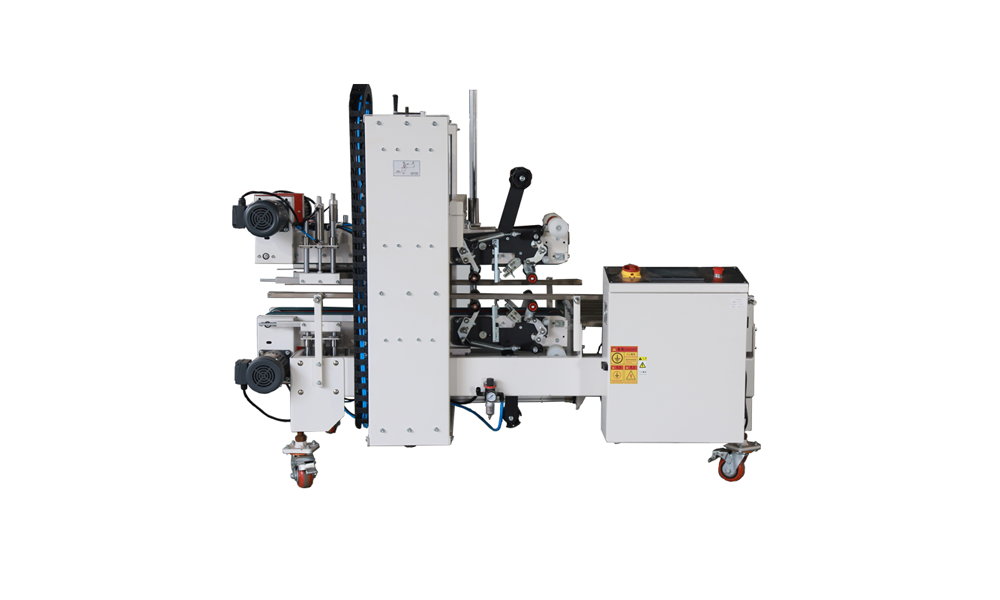
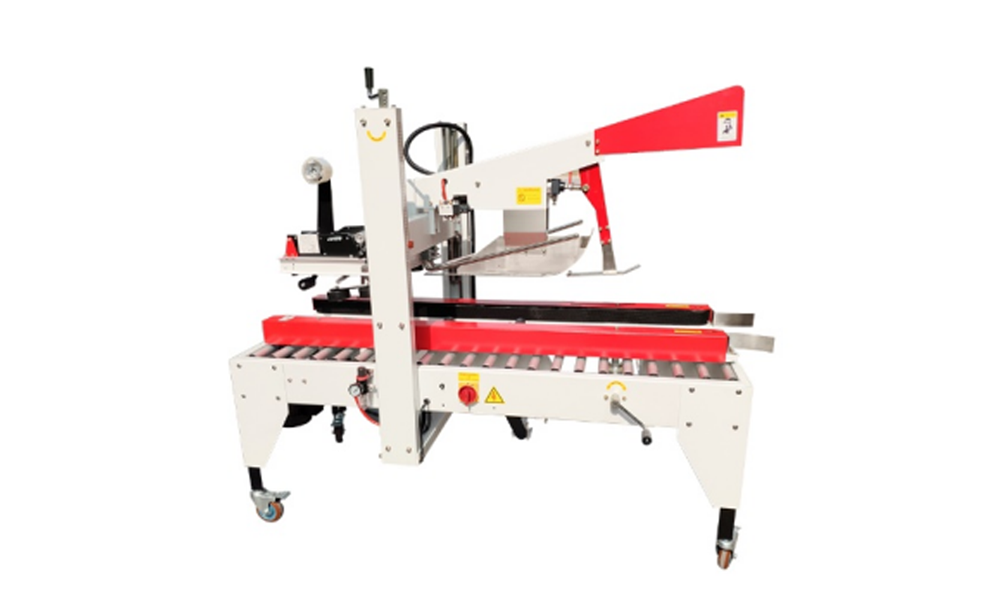
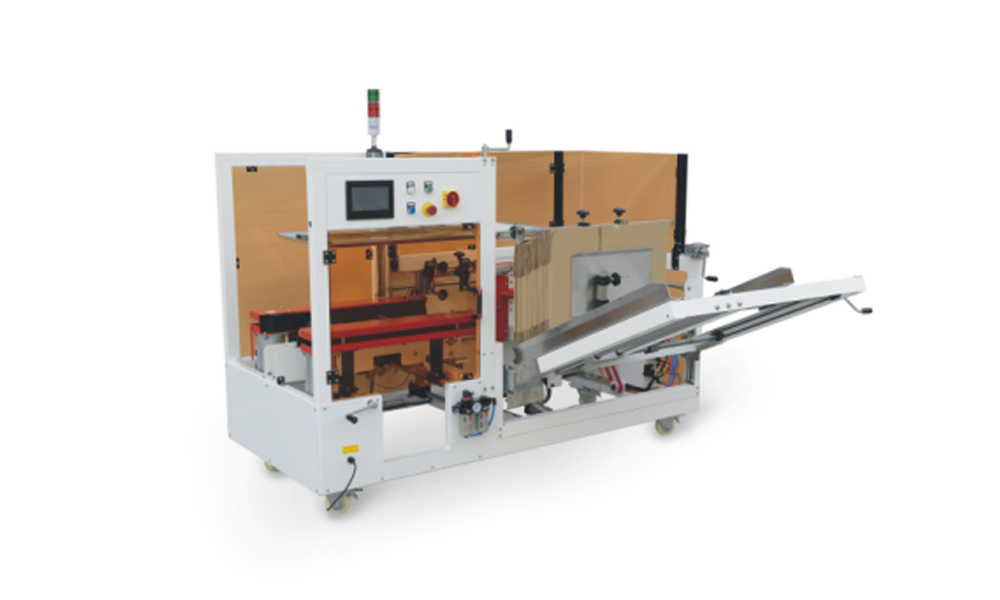
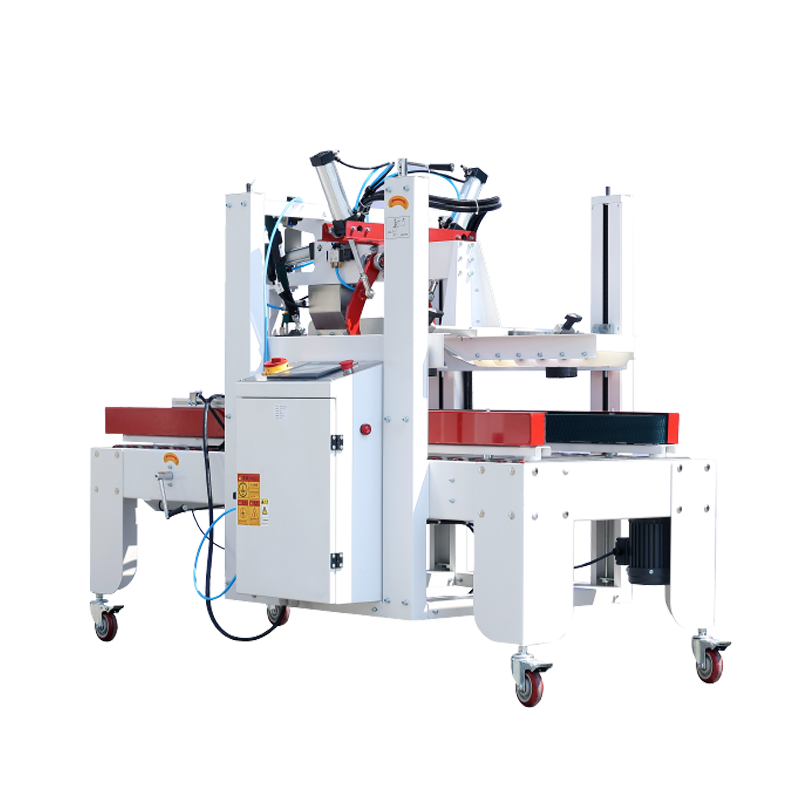
An Auto-Top Case Sealer is a fully automated case sealing machine integrated with an automatic flap closing mechanism. Its core function is to: automatically receive upright, open-top cases from the upstream conveyor, sequentially fold the upright top and bottom flaps flat via precise mechanical mechanisms, immediately apply tape or hot melt adhesive to automatically seal the center seam, and finally discharge a fully sealed case.
Core Value Proposition: To completely replace the manual flap folding action at the sealing station, transforming intermittent human operation into a continuous, stable machine cycle. It eliminates production line fluctuations caused by human fatigue and inconsistent speeds, making it an essential component for building a coherent, efficient, and unattended packaging line.
The machine accomplishes the complex task of flap folding and sealing in an instant through a series of highly synchronized automated motions.
Standard Workflow:
1. Case Infeed and Positioning: The loaded, open case is conveyed into the machine and precisely positioned using photoelectric sensors or mechanical stops before entering the folding zone.
2. Minor Flap Pre-Break: First, a set of guide rods or curved plates inwardly pre-bends the minor flaps on the leading edge of the case, creating the conditions for the main flap fold.
3. Main Flap Primary Fold: As the case advances, the main flaps (major flaps) are impacted by high-speed belts, folding arms, or "woodpecker" mechanisms, achieving a fold beyond 90 degrees.
4. Main Flap Complete Press and Rear Flap Handling: Immediately after, top press beams or belts completely flatten the main flaps. Simultaneously, mechanisms tuck and flatten the trailing minor flaps under or over the main flaps, creating a smooth surface ready for sealing.
5. Automatic Sealing: The case enters the integrated sealing module (typically a standard automatic taping or gluing head) to complete the top seam sealing.
6. Sealed Case Discharge: The sealed case is conveyed to the palletizing area or the next logistics stage.
Overwhelming Advantages vs. Manual Folding or Semi-Auto Sealers:
• High Production Efficiency: Operates in perfect sync with upstream case packers, enabling continuous, stable output at 15-40 cases/minute, 3-5 times more efficient than manual labor.
• Maximum Labor Savings: A single operator can easily oversee multiple production lines, significantly reducing dependence on skilled packers and associated labor and management costs.
• Superior, Consistent Packaging Quality: Machine-controlled fold angles, force, and seal placement ensure uniform, secure, and aesthetically pleasing seals, greatly enhancing outbound product presentation.
• Seamless Line Integration: As a standard interface device in automated lines, it integrates seamlessly with automatic case erectors, packers, checkweighers, labelers, etc., enabling data exchange and true smart logistics.
The performance of a reliable Auto-Top Sealer is defined by several key dimensions:
1. Flap Folding Mechanism Type
• Belt-Folding Type: Utilizes specially angled, high-friction belts to contact and fold the flaps. This mainstream technology offers smooth operation, low noise, and strong adaptability.
• Mechanical Arm-Folding Type: Employs servo-driven robotic arms for precise folding. Its programmable motions offer higher flexibility, especially for non-standard or irregular-sized cases.
• Pneumatic 'Woodpecker' Type: Uses rapidly extending/retracting pneumatic rods to impact the flaps. Relatively simpler in structure but noisier, often suited for medium-low speed lines or budget-conscious scenarios.
2. Size Adjustment and Compatibility
• Adjustment Range: Must cover your current and potential future case dimensions (L, W, H). High-end models feature motorized adjustment, allowing quick changeover within minutes via touchscreen input or recipe recall.
• Material Compatibility: Capable of consistently handling various flute types (from light E-flute to heavy BC-flute) and laminated surfaces without damaging the case.
3. Drive and Control System
• Drive System: Primarily uses servo motors for precise, fast, adjustable, and energy-efficient flap-folding motions.
• Control System: Centered on an industrial-grade PLC with a large color touchscreen HMI. The system should include intelligent functions like fault self-diagnostics, production counting, and maintenance alerts.
4. Line Integration Capability
• Standard Interfaces: The machine should be equipped with standard signal I/O interfaces and mainstream industrial communication protocols (e.g., Modbus TCP/IP, Ethernet/IP) for easy integration with the master line control system.
• Speed Synchronization: Can synchronize its cycle with the upstream packer via signals, operating on a "case present" basis to avoid idle running or congestion.
The need for an Auto-Top Sealer in your line can be determined by answering the following questions:
Prioritize introducing an Auto-Top Sealer if most of the following apply:
• Your upstream line (case erecting, packing) is automated, but the downstream manual folding/sealing has become a clear bottleneck.
• You are planning a new, fully automated packaging line with the goal of a complete unmanned process from empty case to pallet.
• You face persistent labor shortages and rising wage costs, urgently needing fixed-capital investment to replace variable labor costs.
• Your products belong to high-volume industries like FMCG, e-commerce parcels, or food & beverage, with stringent demands for stable, predictable production cycles.
• You place high importance on brand image, requiring 100% uniform and professional outbound packaging.
Consider maintaining the status quo for now if:
• Your current overall line cycle is very slow (e.g., below 10 cases/min) and manual labor fully meets demand, resulting in an excessively long ROI period.
• Your product range is extremely diverse with very low quantities per batch, where frequent mechanical adjustments might reduce overall efficiency.
• There are absolute space constraints preventing the accommodation of the machine's length.
Choosing us means partnering with an organization dedicated to solving root-cause problems, not just selling equipment.
1. Precision Solution Design Based on Bottleneck Analysis
Pre-sales, we offer a complimentary "Line Cycle Time & Bottleneck Diagnostic" service. We assess the true output capability of your upstream equipment and precisely calculate the required speed for the folding/sealing station. This ensures the recommended machine's performance perfectly matches your long-term capacity plan, avoiding both over-investment and under-performance.
2. Mechanical Design Engineered for Stability and Durability
Our Auto-Top Sealer features a fully servo-driven system and a high-rigidity box-frame structure. Critical components like folding belts, drive rollers, and compression mechanisms use imported brands or specially customized materials. This ensures exceptionally low failure rates and long service life under daily high-load operation, delivering the stability and reliability that allows you to "forget it's there."
3. Deep Integration Support and Intelligent Service
Our engineering team is proficient in interfacing with mainstream robots, case packers, and PLC systems on the market. We provide "turnkey" integration, from installation and line commissioning to final acceptance. Furthermore, we offer cloud-based remote monitoring and diagnostic services, enabling proactive identification of potential issues, shifting from reactive repair to preventive maintenance, and maximizing your Overall Equipment Effectiveness (OEE).
Automating the sealing station is the final step in packaging intelligence. The efficiency leap and cost structure optimization delivered by an Auto-Top Sealer will be a solid step in building a robust, competitive supply chain.
Contact our Packaging Automation Consulting team today to initiate a free assessment.
To help us prepare the most targeted preliminary proposal, please provide:
1. Samples or precise dimension ranges of your current shipping cases.
2. The model and approximate cycle rate of your upstream case packing equipment.
3. The current configuration and challenges of your manual sealing station(s).
You will receive:
• A detailed "Feasibility and ROI Report for End-of-Line Automation Upgrade".
• An online session to view live operation of equipment in a similar application.
• A clear Return on Investment analysis model based on your specific data.
Let's collaborate to transform the "manual island" at the end of your production line into an efficient, flowing "automation hub," and step together into the smart future of Industry 4.0.


 English